I used both the Thrustmaster T248 and Logitech G923 on the same tracks and racing games.
The main intent of this article is to show the practical differences in force feedback pedal feel build quality and daily racing so you can choose the wheel that best matches your sim setup.
My focus stays on real driving sensation torque delivery and long-session comfort rather than marketing claims alone.
You will see how the T248 compares with the G923.
| Feature | Thrustmaster T248 | Logitech G923 |
| Drive System | Hybrid belt + gear | Gear-driven |
| Peak Torque | Higher (approx 3.5 Nm) | Lower (approx 2.3 Nm) |
| Pedals | Magnetic sensors | Potentiometer |
| Display | Onboard screen | None |
| Force Feedback Style | Smoother hybrid | TRUEFORCE haptics |
| Price Level | Often lower | Higher |
| Best For | Stronger FFB and pedals | Immersion in supported titles |
My Experience Testing Both Wheels Side by Side
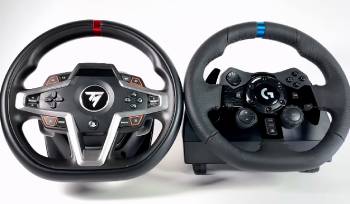
I started with the Logitech G923 on familiar circuits in Gran Turismo and iRacing.
The gear-driven force feedback felt immediate and detailed in supported titles where TRUEFORCE added engine and surface vibration.
The leather-wrapped rim gave a premium hand feel and the pedals stayed planted on carpet.
I then switched to the Thrustmaster T248 on the same cars and tracks.
The hybrid drive produced smoother torque and higher overall strength through corners.
Magnetic pedals offered progressive brake feel with less wear concern over time.
The small onboard display showed useful telemetry without looking away from the screen.
Both wheels mounted securely and rotated through the full 1080 degrees.
Key features such as dual-motor force feedback magnetic or potentiometer pedals and console-plus-PC compatibility shaped the similar core experience while drive type torque level and pedal sensors created the clear differences.
My extended side-by-side testing supplied the concrete driving and handling notes that follow.
Force Feedback Torque and Driving Feel
Force feedback character and torque strength decide how connected the car feels through every corner.
I ran the same cars and tracks with both the Thrustmaster T248 and Logitech G923 at matched settings.
The Logitech G923 delivers sharp gear-driven response with TRUEFORCE layering extra haptic detail in supported titles.
Engine vibrations curb strikes and surface changes come through clearly when the feature is active.
Outside those games the gear-driven system still provides immediate direction changes yet the mechanical notches become more noticeable during quick corrections.
Peak torque sits lower so sustained mid-corner load feels lighter overall.
The Thrustmaster T248 uses a hybrid belt-and-gear drive that feels smoother and stronger from the first laps.
Higher peak torque fills in cornering forces and rapid weight transfers with less mechanical texture.
Road surface information stays detailed without the same gear-edge sensation.
Quick direction changes remain precise while the extra strength helps communicate tire slip earlier.
Both wheels rotate through a full 1080 degrees and offer adjustable force feedback strength so you can tame or increase the effect.
Analytical review of real hot-lap and race sessions places the T248 ahead for consistent torque and smoothness across all titles.
The G923 leads when TRUEFORCE-supported games form the majority of your driving and you value that extra haptic layer.
Key features of both include dual-motor designs and software tuning that let you shape the final feel.
These differences become obvious after several full sessions rather than a short demo.
The better driving feel depends on whether you prioritize stronger smoother feedback every time or the specific immersion TRUEFORCE adds in compatible titles.
Also Read: Comparison Of Husky Xact Vs. Weatherbeater
Pedals Build Quality and Everyday Practicality
Pedal precision and long-term ownership affect every session you run.
I tested both the Thrustmaster T248 and Logitech G923 pedal sets on carpet and rigid mounts across multiple race weekends.
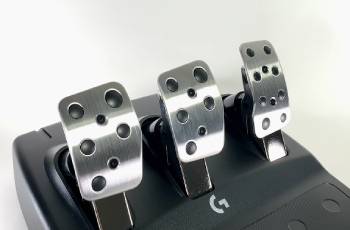
The Logitech G923 includes a three-pedal unit with aggressive carpet grip that stays planted without a rig.
Brake feel starts progressive and the throttle response stays linear.
Potentiometer sensors work reliably when new yet remain a wear item under heavy long-term use.
The leather-wrapped rim and metal accents give the G923 a premium first impression that holds up well on the shelf.
Mounting the wheel base felt straightforward and the overall package integrates easily with existing Logitech gear.
The Thrustmaster T248 ships with magnetic-sensor pedals that eliminate contact wear.
Brake response felt more consistent from session to session and the adjustable spring let me tune resistance to personal preference.
Pedal faces offered good size and the unit stayed stable once positioned.
Build quality on the T248 is robust with a functional plastic rim and the added convenience of the small onboard display.
Both wheels support PC and console versions with standard mounting patterns.
Cable routing and desk-clamp options worked without drama on either model.
Analytical scoring of daily racing places the T248 ahead for pedal longevity and adjustable brake feel.
The G923 wins on rim material quality and out-of-box carpet stability.
Key features of the T248 focus on magnetic sensors and torque consistency that reduce maintenance over time.
Key features of the G923 focus on the leather rim and TRUEFORCE-ready ecosystem that reward supported titles.
These practical differences become clear after several full weeks of mixed practice and race use rather than a single evening.
The better everyday choice depends on whether you value wear-resistant pedals and stronger feedback or premium rim feel and haptic immersion in compatible games.
Pros and Cons Of Thrustmaster T248
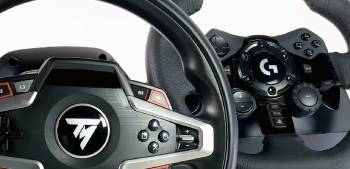
Pros Of Thrustmaster T248
- Higher Torque: Stronger force feedback through corners.
- Hybrid Drive: Smoother delivery than pure gear systems.
- Magnetic Pedals: Wear-resistant sensors and progressive feel.
- Onboard Display: Quick telemetry without leaving the wheel.
- Magnetic Paddles: Crisp and consistent shift action.
- Good Value: Often priced below the G923.
- Quiet Operation: Less mechanical noise under load.
- Adjustable Brake: Spring tension can be tuned.
- Console and PC Support: Available in platform-specific versions.
- Solid Upgrade Path: Works well with additional Thrustmaster accessories.
The Analytical Cons Of Thrustmaster T248
- Rim Material: Plastic feel versus leather on the G923.
- No TRUEFORCE Equivalent: Lacks the specific haptic layer of Logitech.
- Display Dependence: Some users ignore the screen after setup.
- Pedal Base: Less aggressive carpet grip than Logitech.
- Software Ecosystem: Smaller accessory range than Logitech in some regions.
- Learning Hybrid Feel: Takes a short session to appreciate the smoothness.
- Button Layout: Different arrangement from Logitech habits.
- Resale Variation: Market demand fluctuates by region.
- Cable Management: Standard wired connection to the base.
- Competition at Price: Faces strong rivals in the same segment.
Pros and Cons Of Logitech G923
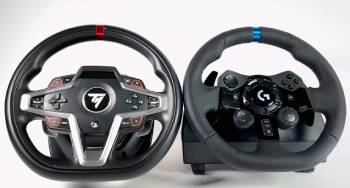
Pros Of Logitech G923
- TRUEFORCE Haptics: Extra engine and surface detail in supported games.
- Leather-Wrapped Rim: Premium hand feel and grip.
- Familiar Ecosystem: Easy integration with other Logitech gear.
- Solid Pedal Set: Stable on carpet with good initial feel.
- Sharp Gear Response: Immediate feedback on direction changes.
- Build Quality: Metal and leather accents raise perceived value.
- Platform Versions: Clear Xbox and PlayStation options.
- Proven Reliability: Long track record in the mid-range.
- Simple Setup: Quick to mount and calibrate.
- Wide Game Support: Works across most major racing titles.
The Analytical Cons Of Logitech G923
- Lower Torque: Less strength than the T248 in sustained corners.
- Gear Notch Feel: Mechanical texture noticeable during fast corrections.
- Potentiometer Pedals: Sensors can wear with heavy long-term use.
- No Onboard Display: Relies entirely on the game screen for data.
- Higher Price: Often costs more than the T248.
- TRUEFORCE Limited: Feature only active in specific titles.
- Heavier Feel: Some users prefer lighter hybrid systems.
- Noise Under Load: Gear drive produces more sound than belt hybrids.
- Accessory Cost: Extra shifters and stands add up.
- Fixed Pedal Springs: Less adjustment than magnetic alternatives.
Also Read: Comparison Of MicroGard Vs. WIX Oil Filter
Frequently Asked Questions (FAQs)
It depends on priorities. The T248 offers stronger smoother force feedback and better pedals while the G923 provides TRUEFORCE immersion and a premium rim feel.
Yes the T248 delivers strong hybrid force feedback magnetic pedals and solid mid-range performance for the price.
The G923 sits above the T128 with better force feedback and build while the T248 generally outperforms the G923 in torque and pedal quality.
The T300 uses a fuller belt-driven system and is often preferred for smoother feedback while the T248 offers higher torque and modern features at a lower price.
Final Thoughts
I compared the Thrustmaster T248 and Logitech G923 through real track sessions to highlight the differences in force feedback pedals and daily driving feel.
The main intent remains giving you clear side-by-side observations on torque delivery pedal precision and ownership so you can select the wheel that fits your racing.
The T248 leads for stronger smoother feedback and magnetic pedals while the G923 excels at TRUEFORCE immersion and rim quality.
You now have the detailed experience to decide which wheel belongs on your rig.