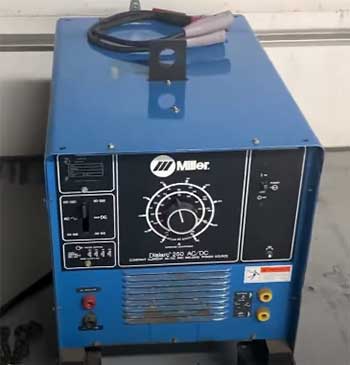
Miller is an excellent choice of brand when you think about welders. But once you enter their product line, you will have difficulty choosing between Miller 252 and 255.
The main difference between these two welders is the processing capabilities and the weight. The Miller 255 can go through multiple welding processes and are much lighter.
Are these the only differences?
Well, no, there are several other differences you will get to see between the two options. Here, I will take you through some of them with an in-depth comparison of the two welders.
A Quick Comparison Table
| Specifications | Miller 252 Welder | Miller 255 Welder |
| Weight | 205lbs | 84lbs |
| Processing capabilities | MIG and Flux cored | MIG, Pulsed MIG, Flux cored |
| Ease of use | A bit critical | Beginner friendly |
| Pricing | Lower | Higher |
| Performance | Powerful | Efficient and powerful |
Key Differences Between Miller 252 And 255 Welders
- Performance
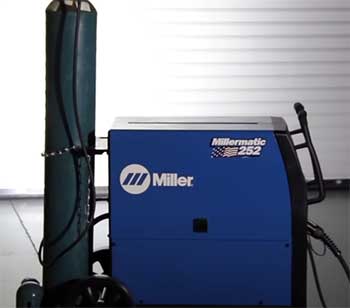
One factor you will always keep in mind about the welding machine is its performance.
How good or bad the machine performs is undoubtedly something to consider. I have a slight difference in performance between the two options I have for you here.
First of all, the Miller 252 performs exquisitely. You get pretty high output from the welder, which lets you weld for a more extended period on any higher-end application.
The power you get from the welder is enough to get you through most projects.
As for the Miller 255, it’s more about efficiency besides performance. The machine works so well within limited power that you can’t even complain about it.
You don’t have to worry about the power coming from the welder. It can take you through most welding processes.
Now, when it comes to choosing one or the other, it’s all about preference. I mean, in general, you would surely want a welder that’s much more efficient.
So, in that aspect, Miller 255 is a slightly better option since it’s the upgraded version of Miller 252.
Also Read: Problems With Miller Multimatic 220 Welder.
- Weight
The weight factor here mainly treats the portability aspect of your welder. A lighter welder is easy for you to move around and work with. And you get to make that choice with these welders as there is a significant difference in the weight.
Miller 252 weighs about 205 lbs. While it’s standard for a welder, it’s much heavier than the Miller 255. The Miller 255 only weighs 84 lbs. The difference is very significant with the weight.
If you are thinking about getting a welder that can move around a lot, then Miller 255 will be a clear choice. It’s so lightweight that you can work with the machine wherever you want.
But if it’s more about staying in a place and enjoying something sturdy, then I have to go with the Miller 252.
- Processing capabilities
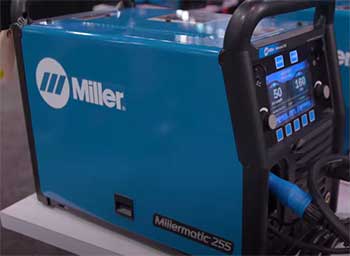
What types of welding you can do with the machine has a crucial impact on the decision.
You can decide on one of these welders based on the kinds of projects you want to do with them.
With the Miller 252, you can only do one type of welding. It only serves the purpose of MIG or Flux-cored welding.
You can do any MIG welding project with the welder, and it will get your job done without any trouble whatsoever.
On the other hand, you have the Miller 255, which serves multiple welding purposes. You can use this welder for pulsed MIG welding along with the bare MIG or flux-cored welding process.
The option to do pulse MIG welding makes this welder an excellent choice for modern-day welding. You can have welding projects without too much spatter or distortion in the welding process.
Overall, I would say, if you are thinking about basic MIG welding, then you can go with either of them. But if you want more out of your welder and need the Pulse MIG welding feature, you must go with the Miller 255.
- Ease of use
Do you care about how easy the machine is to use? If that’s you, then this is a factor that can dictate the decision of choosing between the two welders. There is a difference in the difficulty of using the two welders.
The Miller 252 is a more traditional MIG welder than most professional welders. There is a digital panel where you can see all the parameters and get tuners to adjust all the settings. You will need to work around the welder for a while to figure out the settings.
In comparison, Miller 255 is a much easier machine to use. First of all, there is an LCD screen where you can see all the settings coming up. You can easily adjust them by looking at the screen, and there are several buttons you can use to tweak the settings. All of these features make it very beginner friendly for everyone to use.
So, I would say, if you are a beginner or thinking about getting something easy to use, then choose the Miller 255. But if that doesn’t matter too much to you, then you can still select Miller 252.
- Pricing
Now, let’s discuss the pricing. There is a difference in the prices of both welders.
If you want to save money on your welding machine, go with Miller 252. It’s more affordable compared to Miller 255. There are several reasons for that. The first one is that Miller 252 doesn’t have as many advanced features as the Miller 255.
So, you have to decide on the fact that, whether you want to pay that extra money for the additional features. Also, if you are a beginner, I would still say go with the Miller 255 even with the higher price because you will have a much easier time with it.
Pros of The Millermatic 252
- Power that does not feel nervous: The 252 has mass behind the arc. On 3/16 in and 1/4 in mild steel with .035 wire and C25, the puddle sits where I put it. Spray transfer on thicker plate feels predictable. I do not chase voltage drift the way I sometimes do on lighter inverters when the shop lights dim.
- Simple controls that stay out of the way: Knobs and meters match how a lot of production welders already think. Set voltage. Set wire speed. Weld. I can walk a new hire through it in minutes without explaining menus. Self-calibrating meters let me preset before the trigger pull, which matters when I am repeating the same joint all afternoon.
- Industrial input options: The 230/460/575 V version still matters in plants that live on higher single-phase taps. If your building already feeds that machine, you are not shopping for a new circuit just to modernize the brand.
- Gun switching without extra boxes: Auto-Gun Detect and native support for Spoolmatic and XR guns keep aluminum work inside the same cabinet. I do not buy a separate control module to run a spool gun. That is still a strong shop feature.
- A reputation built on years of abuse: Shops keep 252s for a reason. The transformer design is familiar to service techs. Parts paths are well known. If your crew already knows this machine, downtime stays short.
Cons of The Millermatic 252
- Weight that owns the floor: Two hundred five pounds is not a portable welder. Moving it between bays means a cart, a ramp, or two people. If you weld on site, on a trailer, or in a second building, that weight becomes the whole conversation.
- No pulsed MIG: Thin stainless, thin aluminum, and tight corners pay for pulse. The 252 does not have it. You manage heat with travel speed, weave, and settings. That works. It is just older technique on modern thin stock.
- Duty cycle drops at the high end: You get 250 A, but the 40 percent duty cycle at that output means rest time on long, hot beads. For production spray work, I watch the clock more than I do on the 255 at 230 A and 60 percent.
- Older interface on a machine that still costs industrial money: Digital meters are fine. They are not Auto-Set Elite. New operators guess more. Saved programs do not live in the machine the way they do on the 255.
- Feed path issues if you skip maintenance: Common complaints I see and have felt: birdnesting, liner drag, drive-roll pressure drift, worn contact tips, and stutter after the gun cable gets coiled tight. None of that is unique to Miller. It shows up more on a machine that runs every day and never gets a liner change.
Pros of The Millermatic 255
- You can actually move it: Eighty-four pounds changes how I plan a job. I can lift the power source onto a truck with EZ-Latch gear. I can park it closer to the work instead of dragging a 15-foot gun across the shop. That alone sold several people I work with.
- Pulsed MIG that earns its keep: Pulse cut spatter and heat on stainless sheet and aluminum. Edges stay cleaner. I grind less. Distortion drops on thin panels. That is not a brochure line. That is the difference between a part that stays flat and a part that walks.
- Auto-Set Elite and memory that speed changeovers: When I swap from 16 gauge to 1/4 in, I am not hunting a door chart for five minutes. I pick material and thickness, then fine-tune. Saved programs bring back yesterday’s aluminum settings without rewriting them from memory.
- Wider amp and wire-speed window: Twenty to 350 A and 800 ipm give more room on both ends. Thin starts feel less brutal. Thick single-pass work has headroom. Official steel capacity still tops out at 1/2 in, same neighborhood as the 252, but the inverter holds a tighter arc on stainless in my hands.
- Better generator and dirty-power behavior: Auto-Line and inverter architecture handle uneven shop power and a 12 kW generator better than I expected from a transformer brick. Field repair work is less of a gamble.
- AccuLock consumables and the MDX-250 grip: Front-loading liner alignment cuts birdnests that come from a liner that walked out of place. The handle is easier on a long shift. Small things. They add up when you weld for hours.
Cons of The Millermatic 255
- Price of admission: You pay for the screen, pulse, and weight cut. If you only weld 3/16 in mild steel eight hours a day in one bay, that extra money does not always return.
- Electronics instead of iron: Inverter boards, fans, and error codes replace a simpler transformer stack. Overtemp, trigger errors, motor tach errors, and fan errors show up in the manual for a reason. A nearby surge can take out control electronics faster than it kills an old transformer tank.
- Pulse and menus can slow a stubborn operator: If you refuse the screen and weld like it is 2008, you leave value on the table. Some welders also notice door-chart wire speeds that do not match their 252 numbers. The volt-amp curve is different. You retune. You do not copy the old chart blindly.
- Stock TIG and stick are not on this machine: The Millermatic 255 is still a wire machine. If you need lift TIG and stick in the same box, you are looking at the Multimatic 255, not this one. Mixing those names is how people buy the wrong welder.
- Uphill wire feed and liner wear still exist: I have seen the 255 hesitate when pushing wire up a tall joint with a coiled gun. Flux-cored knurl debris still eats liners. Pulse does not fix a dirty liner.
Which One Is The Best Pick For You?
This is where you have to consider all the factors I discussed in the comparison and find the perfect choice for your purpose. You can easily decide between them based on some factors. Here’s how you can do it.
If you are thinking of an affordable welder that can do MIG welding projects, Miller 252 is a good option. For people who need a lightweight welder along with a pulsed MIG welding feature, Miller 255 is the perfect way to go.
So, it all comes down to what you need for your projects. If you plan to do pulsed MIG welding, Miller 252 is your only choice. Get to know more from this video.
Also Read: Differences Between MIG Steel C25 And C100 Shielding Gas.
Frequently Asked Question (FAQ)
The Miller 252 welder is used for MIG and Flux cored welding.
The Miller 255 amps draw about 175amps at a 60% duty cycle.
No, you can’t do TIG welding with Millermatic 255. However, you can do TIG and other welding processes with the Multimatic 255.
Yes, Miller 252 is a single-phase welder.
Conclusion
Summing up, Miller 252 vs. 255 is about the projects you want to do with them. Since Miller 252 can’t do pulsed MIG welding, you can’t choose it if that’s your purpose.
So, deciding on the welder is very easy. You have to go through what they can do and what they can’t. The comparison will surely give you a clear idea of the choice.