You’ll have countless options if you put some lights on the list of high-end stick welders. But unfortunately, most of them will break your sweat as they’re relatively tough to operate!
So after digging deeper, I’ve got the Miller Dialarc 250 known for its single-dial control, multi-functional nature, and low maintenance facility. Let’s go through the detailed review for a detailed understanding.
My Time On The Miller Dialarc 250
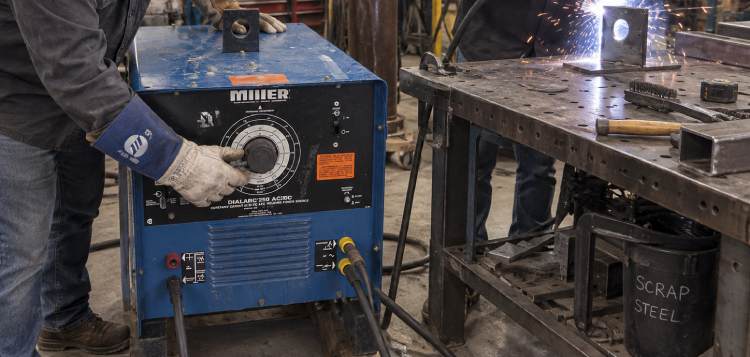
I did not buy this machine because a brochure told me to. I bought it because the shop I walked into already had one bolted to a cart, the leads were chewed, and the owner said, “If you can make that thing talk, you can stay.”
I stayed. That Dialarc 250 became the box I reached for when a trailer tongue cracked, when a loader bucket needed a patch, and when a customer wanted a gate that would not sag after the first winter.
You feel the weight the first time you try to scoot it. Around 360 pounds is not a toy. I stopped pretending it was portable and treated it like a shop fixture. Once it sat on a cart with decent wheels and a pair of fat copper leads, the personality showed up.
You flip the power, pick high or low range, spin the dial, and the arc comes on with that old transformer growl. No menu. No firmware. No “wait while I boot.” You and I both know how rare that feels now.
Stick work is where this machine earns its keep. I burned 3/32 and 1/8 7018 on structural steel and the puddle stayed calm if I kept my travel even. 6010 dug like it should on rusty farm steel. You can feel the machine push back a little when you stretch the arc, then settle when you drop in close.
That magnetic-amplifier control is not as snappy as a modern inverter, but it is predictable. After a week I stopped staring at the scale and started welding by sound and puddle.
I also used it for scratch-start TIG on mild steel when I did not want to drag out a dedicated TIG rig. It is not a Syncrowave. Do not expect a pretty high-frequency start unless you have the HF package or an add-on unit.
What you do get is a steady DC current that will make a usable bead on brackets, tabs, and tubing if your hand is honest. Aluminum is possible on AC with the right setup, and I have seen shops do it, but I kept aluminum on a different machine because I wanted better cleaning action and a foot pedal that felt modern.
Power was the part that taught me humility. This thing drinks input current. On a generator without power-factor correction, I watched a 120-amp stick pass trip a breaker that a smaller inverter would have ignored. In the shop on a proper 230-volt single-phase circuit, it behaved.
You need to respect the duty cycle. Rated output sits near 225 amps AC at 30 percent and about 175 amps DC at 50 percent, depending on the exact rating plate. That means you weld, you rest, you weld again. I learned to plan beads instead of trying to burn a 20-foot fillet in one go.
What sold me for the long haul was boredom in the best way. Months went by and the machine just ran. Fan spun. Dial still matched the puddle close enough. Terminals needed a wrench now and then.
That is the kind of product I tell you to buy when you are tired of replacing circuit boards.
Features of Miller Dialarc 250 Welder
- Single-dial Controlling System
Controlling a welder is a nightmare for some people, especially those who don’t know the easy and correct way to operate it.
Fear not, even if you’re quite new in the world of welding!
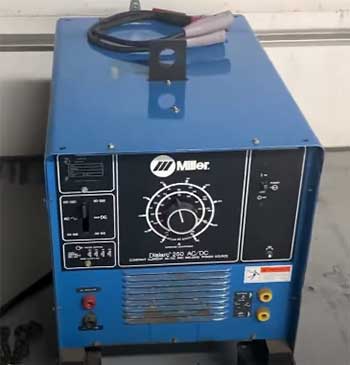
The Miller Dialarc 250 features a single-dial operating system, which ensures easy-peasy and accurate weld output.
Moreover, users can get the perfect heat required to generate a better weld. As a result, you can keep on stick welding without complications.
Thanks to the single-dial controlling system, you just have to plug the welder into any nearest socket and turn on the welder to get your desired task done.
There is no rocket science at all!
Also Read: Is Lincoln AC/DC 225/125 Stick Welder Worth It?
- Multi-functional
Whether construction, railcar, infrastructure, shipbuilding, or anything else, Miller Dialarc can deal with all different projects. Its efficient power-supplying ability gives your stick welder maximum capabilities to perform multiple tasks simultaneously.
Even for myself, Miller Dialarc was an excellent choice for working with manufacturing and heavy-duty welding. So I’d say it is an all-in-one Dialarc welder that can easily stand a spot in your “top-priority chart.”
According to some customers’ opinions, the Miller Dialarc is not only best for stick welding, but it also serves pretty well when you tend to perform TIG (Tungsten Inert Gas) welding. You must avoid maxing the power up, reducing the chance of overheating issues.
- Both AC and DC Compatibility
Alternating and direct current have unique characteristics, pros, and cons. The current market features many high-end welders, but only a few are friendly with both AC and DC.
Even if you can get a welder with both DC and AC compatibility, that will cost you an arm and a leg!
But now, you can wave off your worries as the Miller Dialarc 250 get you covered with its dual current settings. It lets you have greater control throughout the welding procedure by changing the current mode while needed.
For this, note that the amp rate should be 225 for alternating current and 175 for direct current.
- MA Fully-varnished Technology
Welder maintenance can be back-breaking, especially if you don’t know how.
Besides, chances are your welder may turn weaker over time if it requires excess maintenance, yet you cannot do it.
Luckily, this won’t be the case with the Miller Dialarc 250.
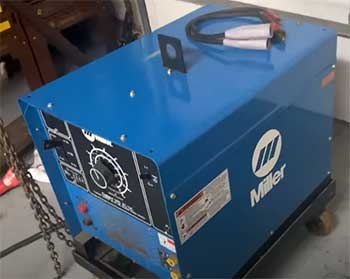
Unlike the mainstream welders, this one requires lower maintenance, thanks to the magnetic amplifier and fully-varnished technology.
On top of that, the moving parts are relatively fewer than the traditional welders, ensuring outstanding reliability.
- Friendly with 7018 and 6010 Electrodes
I use 7018 welding electrodes often, as it’s an ideal choice for regular stick welding applications. But later on, I learned that it is also compatible with the 6010 electrodes, allowing you to weld through sheet metals, thin steels, and so forth!
The best part is that Miller Dialarc 250 is known for welding tough-to-weld metals. In this way, it enables the unit to handle almost every stick welding requirements that you prefer.
- Built-in Cooling Fan
Welders need to bear lots of torture or pressure when you use them for an extended period. So they require to stay out of overheating issues. Otherwise, there is a chance that your welder will stop working in the middle of your project.
That’s where you can feel the necessity of having a particular cooling fan. Fortunately, the Miller Dialarc 500 comes in an extra forced-draft fan, keeping the whole unit cool throughout the welding procedure.
This way, it also ensures the longevity of the power source by keeping the machine free from overheating problems.
- Additional Remote Control System
What if you can control the welder, even by keeping yourself away from the machine? This can only happen if you get a welder with an extra remote controlling facility.
So, guess what? Here comes the most striking feature that I loved most! In this budget segment, the Miller Dialarc has offered an extra remote. As a result, you won’t have to move back to the power source to control the device.
You only need to get the remote and control the welder to save effort and time!
What Could Have Been Better With Miller Dialarc 250?
- Portability Issues
In this category, the majority of welding machines appear to be comparatively light in weight. Having a portable welder is a plus so you can move it quickly from home to the garage.
But unfortunately, Miller Dialarc has got a bulky weight. Weighing around 360lbs, you’ll find it tough to transfer from place to place, especially when you tend to move it with your bare hands.
So, I’d suggest taking help any transportation systems for better portability.
- Didn’t Mention Clearly About the Warranty
Warranty information is one of the crucial facts to consider, especially when we buy welders or such pricey equipment. If a product offers a long-term warranty, most of us can stay relaxed in fixing the issues regarding our devices.
When it comes to the Miller Dialarc 250, the manufacturer of it doesn’t clarify the warranty information online. As a result, I’d suggest you ask the seller about it before you buy so that you can know how long it serves the warranty facilities.
Maintenance And Tips For Miller Dialarc 250
- Give The Machine Air And Keep The Fan Honest: Unplug it first. Always. Then treat cooling like it is part of the weld. The forced-draft fan is why this transformer lasts. I blow the interior with dry compressed air on a schedule, more often if grinders live nearby. Dust on windings and the rectifier is slow damage. Listen when you power up. If the fan is silent or the blades scrape, stop welding and fix that before you chase arc quality. Keep 18 inches of clearance around the case so the intake is not sucking cardboard and gloves.
- Treat Duty Cycle Like A Contract: At higher AC output you are looking at roughly three minutes on and seven minutes off. On DC at the rated current you get a more even split. I keep a cheap timer in my head: weld a pass, chip, brush, check fit, let the box breathe. If the machine feels hotter than usual, drop amperage or shorten the bead. Exceeding the rating does not make you tougher. It cooks insulation. Plan multi-pass joints on thick steel instead of one heroic puddle.
- Size The Circuit And The Cables For Reality: This welder wants a dedicated branch that matches the rating plate. Jumper links must match your incoming voltage. Wrong links give you weak output or a very bad day. Use copper weld cable sized for the current and the round-trip length. Undersize cable turns into a heater and your puddle goes mushy. I prefer a heavy ground clamp on clean metal, not on paint, rust, or a spinning caster. Clean and tighten the output terminals every few months. A loose lug looks like a “bad machine” until you put a wrench on it.
- Store Rod Like You Mean It And Match Process To Range: 7018 that sat in a damp truck bed will make any welder look worse than it is. Keep low-hydrogen rod in an oven or a sealed can. 6010 and 6011 are more forgiving on dirty steel, which is why I keep both on the rack. Use the low range when you can. The dial has more resolution and the arc feels easier to hold on thinner stock. High range is for thicker work and larger electrodes. If a setting sits in the overlap, I choose low first.
- Know What TIG On This Box Really Requires: Scratch-start DC TIG is workable for steel brackets if you are patient. A high-frequency start and a foot amp control turn the machine into something friendlier, which is why HF versions and add-on panels exist. Gas, tungsten, and a decent torch matter more here than on a purpose-built TIG inverter. I keep TIG sessions short enough to respect duty cycle and I do not pretend this is an aluminum production machine unless the setup is complete.
- Inspect Leads, Labels, And The Obvious Faults First: Cracked insulation, a cooked stinger, or a ground clamp with no spring left will ruin a bead faster than a tired transformer. Replace unreadable warning labels so the next person in the shop is not guessing. If output dies, I check incoming power, the disconnect, fuses or breakers, jumper links, and weld connections before I invent a ghost. Erratic output is often a dirty terminal or a cable that has been coiled into a heating loop. Low output after a long life can be links, input voltage, or a machine that was run too hot for too many years.
- Move It Like Equipment, Not Like A Toolbox: Do not drag it by the leads. Do not park it where a fork can clip the case. A simple cart with locks on the wheels turned mine from a statue into a bay tool I could square up to a table. After you move it, confirm the case is level enough that the fan and internals are not stressed, then check terminals again. Vibration loosens hardware. That five-minute habit has saved me more hours than any fancy upgrade.
Also Read: Differences Between Miller 252 And 255 Welders.
Frequently Asked Questions (FAQ)
As I’ve mentioned earlier, the Miller Dialarc 250 weighs around 360lbs. This makes it a bit weightier than the traditional welders.
If you’re looking for a stick welder that gives more bang for your buck, then I’d say the Miller welder is a suitable choice. With versatility, affordability, and ease of use, it has everything to be the topper.
There is no definite answer about which one stands out among Lincoln and Miller because each has its specialties, characteristics, and limitations.
But I’d say Lincoln gets more fame for its high-end stick welders, while Miller earns popularity for manufacturing some of the top-class TIG and MIG welders.
To get the best quality, performance, and longevity, sometimes it’s necessary to spend a fortune.
So when we talk about Miller Welders, they mainly offer heavy-duty and high-performing welders for different materials. This might be the reason behind their expensive price tag.
Last Words!
Stick welding is easy and becomes easier when you have the right tool. The purpose of compiling the Miller Dialarc 250 reviews is to let you get familiar with such a model that has everything you prefer.
If you can avoid the issue regarding portability and warranty information, I can ensure that it won’t let you down because it is versatile and long-lasting.