When you are out on the open road, the last thing you want is a surprise encounter with a patrol car that costs you hundreds of dollars.
I have spent countless hours driving with both the Uniden R4 and the Uniden R7 to see which one truly offers the best protection for the modern driver.
In this article, I will compare these two heavyweights to determine if the newer R4’s sensitivity can beat the R7’s legendary directional arrows.
Whether you want maximum distance or total situational awareness, I’ll help you decide which unit belongs on your windshield.
Uniden R4 Vs. R7 Comparison Table
| Feature | Uniden R4 | Uniden R7 |
| Antenna Design | Single Antenna (Forward Only) | Dual Antenna (Front & Rear) |
| Directional Arrows | No | Yes (360° Awareness) |
| LNA (Amplifier) | Dual LNAs (Extreme Sensitivity) | Standard LNA |
| Auto-Lockouts | Yes (Automatic Learning) | Manual Only (User Marks) |
| Bluetooth | Yes (Built-in) | No |
| Filtering | Advanced BSM & K-Block | Good BSM Filtering |
| Camera Database | Red Light & Speed Cameras | Red Light & Speed Cameras |
| Platform | Newer (Next-Gen) | Older (Established) |
The Uniden R4: A Performance Beast in a Compact Box
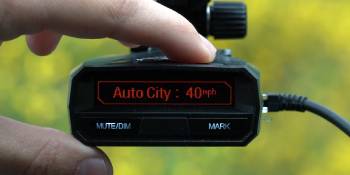
I remember the first time I mounted the Uniden R4 in my daily driver.
It felt like I was carrying a miniature version of a military-grade radar station.
The R4 is the successor to the famous R3, but it has been upgraded with dual Low Noise Amplifiers.1
In my experience, this makes it one of the most sensitive single-antenna detectors I have ever used.
It can sniff out a Ka-band signal from miles away, often giving me enough time to have a full conversation before I even see the source.
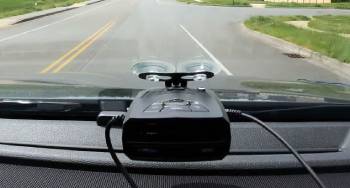
I really appreciate how compact the design is, as it doesn’t block much of my view through the windshield.
The inclusion of Bluetooth is a huge win because I can finally connect it to apps to manage settings or get real-time crowd-sourced data.
One thing I noticed immediately was the “Auto-Lockout” feature.
Unlike older models, the R4 actually learns where the false alerts are—like grocery store doors—and mutes them automatically after a few passes.2
This makes my daily commute through the city much quieter and less stressful.
Pros and Cons of the Uniden R4
Pros of the Uniden R4
- Extreme Range: The dual LNAs provide some of the best forward-facing range in the industry.
- Automatic Lockouts: It saves you the hassle of manually muting the same false signals every day.
- Bluetooth Support: Allows for easy firmware updates and integration with third-party driving apps.3
- Price Point: It generally offers more “raw” performance for the money than almost any other detector.4
Cons of the Uniden R4
- No Directional Arrows: You know there is radar nearby, but you don’t know if it is in front of or behind you.
- Chattiness: Because it is so sensitive, it can be a bit loud until it learns your frequent routes.
- Mounting: The single-cup mount is okay, but it can vibrate a bit more than the heavy-duty R7 mounts.
The Uniden R7: The King of Situational Awareness
Whenever I switch back to the Uniden R7, I am reminded why so many people refuse to give it up.
The directional arrows are the star of the show here.
If the detector goes off, I look at the screen and instantly know if the threat is ahead, behind, or to the side.
This 360-degree awareness is something that once you experience, it is very hard to go back to a “blind” detector.
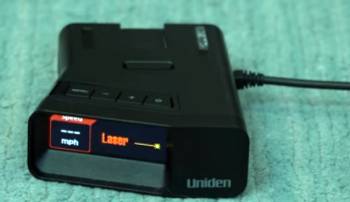
I have found that the R7 is built like a tank; it feels more substantial in the hand and on the dash than the R4.
The screen is larger and can display more information simultaneously, which I find very helpful during long highway trips.
Even though it is on an older platform than the R4, the range on the R7 is still world-class.
It might not have the extreme “off-axis” reach of the R4’s newer amplifiers, but it is no slouch.
The main drawback for me is the lack of automatic lockouts.
If I hit a false alert on my way to work, I have to manually tap the mute button three times to teach the R7 to ignore it.
For some, this is a dealbreaker, but for others, the arrows are worth every bit of manual effort.
Pros and Cons of the Uniden R7
Pros of the Uniden R7
- Directional Arrows: Provides instant feedback on where the radar source is located.
- Large Display: The OLED screen is bright and can show multiple threats at once with ease.
- Solid Build Quality: It feels more premium and durable than the lighter R4.
- Proven Track Record: It has a massive community of users and custom firmware options available.
Cons of the Uniden R7
- Manual Lockouts only: You have to be proactive in teaching the device where false alerts are located.
- No Bluetooth: You are stuck with using a computer and a USB cable for all your firmware updates.
- Physical Size: It is a larger unit, which might be harder to hide or mount in smaller vehicles.
Real World Testing: Range and Sensitivity Comparison
When I took both units out to my favorite test road, the results were very enlightening.
The Uniden R4 is undeniably the more sensitive of the two when it comes to raw distance.
In several “over-the-hill” scenarios, the R4 alerted roughly 500 to 800 feet before the R7 did.
While that might not seem like much, at highway speeds, those extra seconds can be the difference between a ticket and a safe pass.
The R4 also seems to handle the newer “low-power” radar guns better than the R7.
However, the R7 has a way of making me feel more “informed.”
When the R7 alerts to a signal from behind, I can glance in my rearview mirror and spot the patrol car immediately.
With the R4, I find myself tapping the brakes and scanning everywhere because I don’t know the direction.
If you drive in an area with a lot of “moving” radar—where cops scan while driving behind you—the R7 is much more useful.
If you mostly worry about stationary traps or cops hiding on the side of the road way ahead, the R4’s range is the winner.
Also Read: Comparison Of NOCO GB70 Vs. GBX75
Filtering and False Alert Handling: City vs Highway
Driving through the city can be a nightmare for radar detectors because of automatic doors and blind-spot monitors.
I noticed that the R4 has a slight edge in filtering out modern car sensors.
Its “K-Block” filter is very effective at silencing the signals coming from nearby Mazdas or Hondas.8
The R7 is also quite good, but it requires more manual tweaking in the settings to stay quiet.
The auto-sensitivity feature on the R4 is another huge plus for city drivers.
It uses GPS to see how fast I am going and automatically lowers the sensitivity when I’m driving slowly.
This means the detector stays silent while I’m looking for a parking spot but wakes up the moment I hit the gas on the freeway.
The R7 can do this to an extent with its “Quiet Ride” feature, but it isn’t as seamless as the R4.
In my experience, the R4 is the better “set it and forget it” device for someone who does a mix of city and highway driving.
The R7 is better suited for the enthusiast who doesn’t mind interacting with their gear to get the best results.
Maintenance Tips for Your Uniden Radar Detector
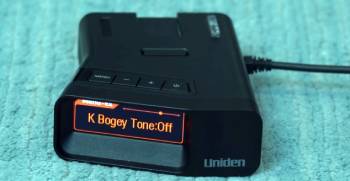
Keeping your detector in top shape is essential for long-term protection.
I always make it a habit to wipe down the front lens with a microfiber cloth every few weeks.
Dust and fingerprints can actually scatter laser pulses, making the detector less effective at picking up laser threats.
You should also check for firmware updates at least once every three months.
Uniden is great about releasing updates that improve filtering for new types of car sensors.
If you are using the R4, you can do this more easily via the app, but R7 users will need to bring the unit inside to a PC.
Avoid leaving your detector in a hot car for extended periods if you live in a sunny climate.
The heat can degrade the suction cups and eventually cause the internal components to age faster.
I also recommend resetting your GPS lockouts once a year.
Sometimes city infrastructure changes, and you don’t want the detector muting a real threat because it still thinks there is a grocery store nearby.
Finally, always check the power cord for any kinks or frays, as a stable power supply is critical for the LNAs to work correctly.
Also Read: Comparison Of Uniden R3 Vs R4
Frequently Asked Questions (FAQs)
It depends on your needs; the R4 has better range and automatic lockouts, while the R7 offers directional arrows for better situational awareness.
Yes, it is currently one of the best single-antenna detectors on the market, offering flagship-level range at a mid-range price.
Absolutely, the R7 remains a favorite because its 360-degree arrows and large screen provide information that the R4 simply cannot.
Yes, the R4 has a built-in GPS database that alerts you to red light cameras and fixed speed cameras as you approach them.
Final Thoughts
When it comes down to choosing between the Uniden R4 and the R7, you have to ask yourself what you value more: raw power or total awareness.
I have found that the R4 is the perfect choice for the driver who wants the longest possible warning and doesn’t want to mess with manual settings.
The automatic lockouts and Bluetooth connectivity make it a modern, user-friendly tool that just works.
On the other hand, the R7 is the choice for those of us who want to know exactly where the threat is coming from at all times.
The arrows are a game-changer that provide a level of confidence that a single-antenna unit like the R4 can’t match.11