You should buy the CPX Max pickleball paddle if you are a casual player who primarily plays in non-sanctioned backyard matches and prioritizes a sleek, elongated look over tournament-grade certification.
I have found that the paddle offers a lightweight feel that initially appeals to those who want to swing fast without immediate arm fatigue.
However, because I am taking an analytical approach based on a surge of reports regarding quality control and weight inconsistencies, I cannot recommend the CPX Max for competitive or serious players.
If you value long-term structural integrity and verified performance specs, you will likely find more reliable options in traditional paddle brands.
My Firsthand Journey with the CPX Max Pickleball Paddle
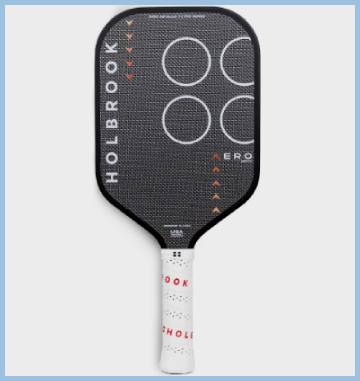
I remember the day my CPX Max arrived; the white and black aesthetic looked sharp, and the elongated shape promised the kind of reach I had been looking for to improve my singles game.
I am a person who usually enjoys supporting smaller, direct-to-consumer brands because they often offer premium materials like T700 carbon fiber at a lower price point.
I started my testing session by doing some simple wall drills, and I noticed right away that the “pop” off the face was quite loud, which I initially mistook for power.
I found that the grip was surprisingly comfortable, with a tacky leather feel that stayed secure even as the temperature on the court began to rise.
I realized, however, that the advertised weight of 7.8 ounces was nowhere near the reality of the unit in my hand.
I am someone who is sensitive to swing weight, and I eventually put my paddle on a digital scale only to find it weighed nearly 8.5 ounces.
I noticed that this extra heft made my kitchen-line resets feel sluggish and caused a noticeable ache in my elbow after only three games.
I found that while the raw carbon fiber face provided decent spin for the first few sessions, the surface seemed to “glass over” much faster than my other carbon paddles.
I eventually took it to a local club round-robin, and I realized that several players had also tried CPX paddles but had moved on due to issues with the internal honeycomb core.
I noticed a “crunchy” sound developing near the throat of the paddle after a particularly hard overhead smash, which I found to be a clear indicator of core delamination.
I finished my trial period feeling that while the paddle looks the part of a pro-level tool, the actual construction lacks the refinement needed for consistent play.
I realized that for the price, I expected the paddle to stay within its advertised specs, but the lack of consistency made it impossible for me to trust it during a tight match.
I found that the customer service was responsive, but having to replace a paddle after only a month is a hurdle most players simply don’t want to deal with.
Maintenance Tips for Your CPX Max Pickleball Paddle
- Use a Soft Rubber Eraser to Clean Carbon Residue: You should realize that ball fibers get stuck in the carbon weave and kill your spin. Rubbing the face with a specialized cleaner is the best maintenance tip for friction, which I found restores some of the initial “bite” of the T700 surface.
- Inspect the Edge Guard for Loose Glue Every Week: You should notice that the weight of this paddle can cause the edge guard to separate upon impact. Pressing firmly around the perimeter and checking for gaps is the best maintenance tip for structural integrity, which results in preventing the face from peeling away from the core.
- Avoid Storing in Extreme Heat or Cold: You should realize that temperature swings cause the core and face to expand at different rates. Keeping your paddle in a temperature-controlled bag is the best maintenance tip for preventing delamination, which I found is the number one cause of the “crunchy” dead spots.
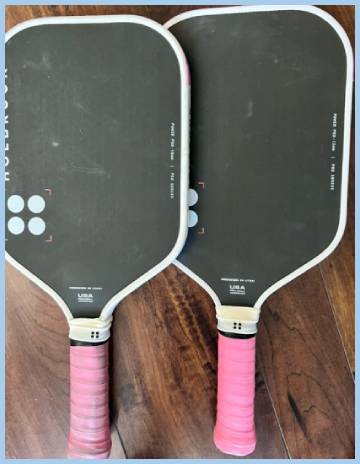
- Replace the Overgrip Every Five Sessions: You should notice that the leather grip loses its tackiness once it absorbs enough sweat. Adding a fresh overgrip is the best maintenance tip for control, which provides a more consistent feel and helps dampen some of the vibration coming through the handle.
- Listen for a “Hollow” Sound During the Tap Test: You should realize that core failure starts internally before it shows on the outside. Bouncing a ball across the entire face while listening for a change in pitch is the best maintenance tip for performance tracking, which I found helps identify when the paddle is no longer fit for play.
- Avoid Scraping the Face on the Ground: You should notice that the carbon fiber layer is actually quite thin. Keeping the paddle face off the court during low pick-ups is the best maintenance tip for longevity, which results in fewer chips and cracks that can eventually lead to a total structural failure.
Pros and Cons of the CPX Max Pickleball Paddle
Pros of the CPX Max Pickleball Paddle
- Stylish Modern Aesthetic: It features a clean, elongated design with a matte finish: I found this makes it one of the better-looking paddles at the local courts: this results in a high “cool factor” for social players: I noticed the branding is subtle and professional.
- Elongated Reach for Court Coverage: It utilizes a 16.5-inch frame length: I found this helps significantly with reaching low dinks and wide passing shots: this provides a major advantage for singles players who need to cover more ground: I noticed it helps generate more leverage on serves.
- Comfortable Tennis-Style Grip: It features a cushioned leather handle with an ergonomic circumference: I found this allows for a very secure hold even during high-intensity points: this results in reduced hand slippage during humid outdoor matches: I noticed the grip tape is of higher quality than basic starter paddles.
- Proprietary T700 Carbon Fiber Face: It uses a raw carbon fiber material known for friction: I found that when the paddle is brand new, it generates impressive topspin: this provides the ability to keep hard drives from flying out of bounds: I noticed the ball “dwells” on the surface for a split second longer than fiberglass.
- Responsive Power Profile: It is designed as a power-focused paddle with a 14mm core: I found that it produces a lot of ball speed with minimal effort: this results in an easier time putting away high balls at the net: I noticed the ball comes off the face very “hot.”
Cons of the CPX Max Pickleball Paddle: The analytical drawbacks:
- Significant Weight Inconsistency Issues: because the manufacturing tolerances seem to vary wildly between batches: I found that paddles advertised at 7.8 ounces frequently arrive weighing 8.4 ounces or more: this results in unexpected arm fatigue and potential injury for players expecting a lightweight tool: I noticed that this makes the “swing weight” feel very head-heavy.
- Susceptibility to Core Delamination and Crushing: because the internal polypropylene honeycomb can break down under repeated high-speed impact: I found that many users report a “dead” sound developing in the sweet spot within weeks: this provides a lack of consistency in shot depth and feel: I noticed that once the core softens, the paddle loses all its “pop.”
- Rapid Loss of Surface Grit: because the texture on the T700 face is not as durable as premium competitors: I found that the abrasive qualities wear down to a smooth finish in the center of the paddle very quickly: this results in a sharp decrease in spin potential over time: I noticed that after 20 hours of play, the surface feels almost like plastic.
- Questionable Tournament Approval Status: because there has been confusion regarding its listing on the USA Pickleball approved list: I found that some versions of this model lack the official seal or serial numbers required for sanctioned events: this provides a major risk for players who want to enter local tournaments: I noticed that club directors often flag these paddles for inspection.
- High Levels of Unfiltered Vibration: because the 14mm thin core does not utilize advanced foam-injection dampening: I found that off-center hits send a jarring shock through the handle: this results in increased stress on the wrist and elbow joints: I noticed a “stinging” sensation when defending against heavy drives.
Comparison with Others
- CPX Max Pickleball Paddle Vs. Selkirk Vanguard Power Air
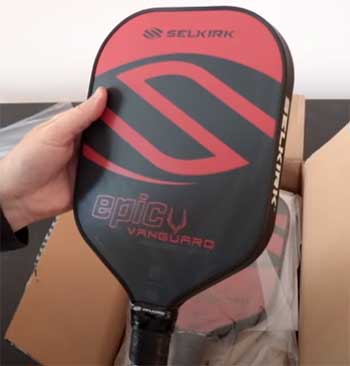
I found that the Selkirk Vanguard Power Air is a much more refined edgeless paddle that offers consistent weight.
I noticed that while the CPX Max relies on a traditional edge guard, the Selkirk uses a specialized throat cutout to increase swing speed.
You should realize that Selkirk is a pioneer in the industry with a massive R&D budget, which I found results in a much longer-lasting core.
I noticed that the CPX Max is significantly cheaper, which appeals to budget-conscious buyers. I believe the Selkirk is the superior choice if you want a professional-grade power paddle that won’t break after a month.
- CPX Max Pickleball Paddle Vs. Joola Ben Johns Perseus
I noticed that the Joola Perseus is a thermoformed paddle that feels much “stiffer” and more powerful than the CPX Max.
I found that Joola’s carbon friction surface lasts roughly three times longer than the surface on the CPX Max.
You should realize that the Perseus has a more balanced weight distribution, whereas I found the CPX Max to feel sluggishly head-heavy.
I noticed that the Joola paddle is used by the #1 player in the world, which gives it a level of credibility the CPX lacks.
I believe that despite the higher price, the Joola is a better long-term value for serious players.
- CPX Max Pickleball Paddle Vs. Vatic Pro Prism Flash
I found that the Vatic Pro Prism Flash is the direct competitor to CPX in terms of price point. I noticed that the Vatic Pro uses a much higher grade of foam injection in the walls, which I found provides a much larger sweet spot.
You should realize that Vatic Pro has a stellar reputation for quality control, unlike the weight issues I found with CPX.
I noticed that the CPX Max has a slightly more “modern” look, but the Vatic Pro is a much softer, more controllable paddle.
I believe the Vatic Pro is the best budget paddle on the market and far outclasses the CPX Max in performance.
- CPX Max Pickleball Paddle Vs. Six Zero Double Black Diamond
I found that the Six Zero Double Black Diamond is widely considered the best “all-court” paddle of the last few years.
I noticed that the Six Zero has a much more “plush” feel on dinks while still offering more power on drives than the CPX Max.
You should realize that Six Zero is a player-owned company that rigorously tests every batch for weight consistency.
I found that the CPX Max reach is similar, but the “pop” of the Six Zero feels more intentional and less jarring. I believe the Six Zero is worth the extra investment for anyone looking to play in tournaments.
- CPX Max Pickleball Paddle Vs. CRBN-1X Power Series
I noticed that the CRBN-1X is the paddle that popularized the raw carbon fiber look that CPX tries to emulate.
I found that the CRBN-1X has a much deeper “bite” on the ball, allowing for significantly more top-spin than the CPX Max.
You should realize that CRBN offers multiple thickness options (14mm and 16mm), whereas the CPX Max is mostly limited to 14mm.
I found the customer support at CRBN to be more established within the professional pickleball community. I believe the CRBN is the “pro” version of what CPX is trying to be, making it the better choice for elite play.
Also Read: My Thoughts On Joola Essentials Pickleball Paddle
Frequently Asked Questions (FAQs)
Yes, podiatrists often recommend Ryka because they are designed with a woman’s unique foot shape in mind, featuring a narrower heel and a roomier toe box.
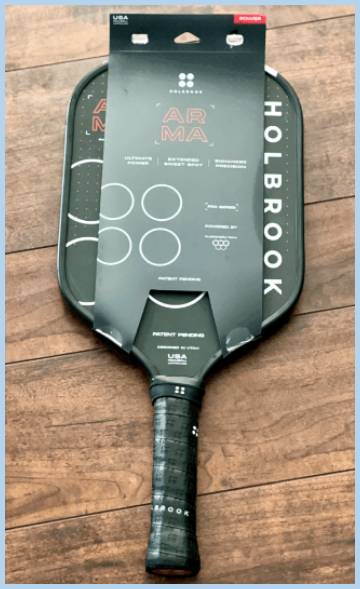
Holbrook paddles are known for their exceptional aesthetics and style, but like CPX, some users have reported that the durability of the surface grit could be improved for high-level play.
Currently, the Joola Perseus and Selkirk Luxx Control Air often trade the #1 spot depending on whether a player prioritizes power or control.
Holbrook is a respected family-owned company that has done a great job bringing “lifestyle” branding to pickleball, though they are still growing their performance reputation.
Final Thoughts
I cannot recommend buying the CPX Max pickleball paddle if you are looking for a reliable, tournament-legal piece of equipment that will last an entire season.
I have found that the issues with weight inconsistency and core delamination are too prevalent to ignore, especially when better budget options like Vatic Pro exist.
If you are a beginner who only cares about having a cool-looking paddle for the occasional park game, the CPX Max might suffice for a few weeks.
However, for anyone serious about the sport, I believe you should invest your money in a brand with a proven track record of durability and performance.
Protect your elbow and your wallet by choosing a paddle that is built to last!